Webinars and Sponsored Roundtables — Register Now

Tuesday, April 28, 2026, 12:00 PM–1:00 PM ET
Discover how next-day comprehensive genomic profiling (CGP) is possible with the Oncomine Comprehensive Assay Plus on the Genexus System—delivering both speed and accuracy.

Webinar presenters Jane Bayani, MHSc, PhD, Assistant Professor and Co-Director, Diagnostic Development, Ontario Institute for Cancer Research, Canada, and Nicola Normanno, MD, Scientific Director, IRCCS Romagnolo Institute for the Study of Tumors, Italy, and Morten Grauslund, PhD, Molecular Biologist, Department of Pathology, Rigshospitalet/Copenhagen University Hospital, Copenhagen, Denmark.

Moderated by: Bob McGonnagle, Publisher, CAP TODAY

CAP TODAY does not endorse any of the products or services named within. The webinar is made possible by a special educational grant from Thermo Fisher Scientific. For Research Use Only. Not for use in diagnostic applications. 

Thursday, April 30, 2026, 11:00 AM–12:00 PM ET
Hear an expert discuss how Memorial Sloan Kettering Cancer Center (MSKCC) is utilizing
the oncoReveal® Nexus 21-gene panel to redefine turnaround time and actionable insights
in cancer care. Dr. Ewalt shares a perceptive look at the clinical need for rapid, front-line NGS sequencing, and how a unique, purpose built targeted NGS panel (Pillar Biosciences’ oncoReveal Nexus 21 gene Panel) was developed, validated and implemented clinically by Memorial Sloan Kettering Cancer Center (MSK-REACT) to complement their current comprehensive genomic profiling (CGP) approach.

Webinar presenter Mark Ewalt, MD, Associate Medical Director for Laboratory Operations for Diagnostic Molecular Pathology in the Molecular Diagnostics Service, Department of Pathology and Laboratory Medicine, MSKCC.

Moderated by: Bob McGonnagle, Publisher, CAP TODAY

CAP TODAY does not endorse any of the products or services named within. The webinar is made possible by a special educational grant from Pillar Biosciences.

Thursday, May 28, 2026, 1:00–2:00 PM ET
This session is designed to improve understanding and application of recent updates to synoptic pathology reporting protocols such as the latest Reporting Template for Reporting Results of Biomarker Testing of Specimens from Patients with Carcinoma of the Breast. These changes reflect evolving clinical guidelines that directly influence diagnostic accuracy and treatment selection in breast cancer care.

Webinar presenters Thaer Khoury, MD, FCAP, Chair, Pathology and Laboratory Medicine, Roswell Park Comprehensive Cancer Cente, and Colin Murphy,  CEO of mTuitive.

Moderated by: Bob McGonnagle, Publisher, CAP TODAY

Subspecialties

Interactive Product Guides

2018 Issues

Q&A column

Q. What is the current standard practice for collection tube order for CSF testing? Read answer.
Q. What is the significance of the absence of coagulation of seminal fluid in a patient who previously experienced normal seminal fluid coagulation, followed by normal liquefaction, and had fathered children? Are there medications that can prevent seminal fluid coagulation? Read answer.

Rapid PCR rules as labs ready flu arsenal

December 2018—With the memory of the 2017–2018 “high-severity” influenza season fresh in mind—49 million cases, 960,000 hospitalizations, a marginally effective vaccine, 79,000 deaths—clinical laboratories have been bracing for the customary annual surge in emergency room, outpatient clinic, and physician office influenza test orders. Although flu admissions have been rising somewhat, it is too soon to know how the season will play out, but laboratories are hoping for a season closer to average. Avoiding a repeat of last year’s travails—lengthy turnaround times, supply shortages, and the need to triage patients for testing—is a must, many laboratory directors say. “We had difficulty keeping up with last year’s demand. It was extremely time-consuming,” says Mary Kay O’Connor, national laboratory director at Summit Health Management, the management arm of the Summit Medical Group, an 800-provider practice on the East Coast.

Multiplex for allergy dx: powerful, but it has its place

December 2018—In allergy testing, microarray technology offers speed and the benefit of smaller sample volumes, but it has a lower sensitivity and is unable to detect IgE antibodies of all specificities in a given extract unless all allergens are on the chip. For routine use, singleplex assays are here to stay.

Could CGM dethrone HbA1c for office-based diabetes care?

December 2018—A glucose sensor the size of a quarter placed on the body and a sensor filament inserted under the skin could potentially disrupt traditional diabetes care with its continuous monitoring of glucose almost 300 times a day. Blood glucose can fluctuate widely during the day even in completely healthy people, said David Sacks, MB, ChB, in an interview with CAP TODAY.

Drug overdose deaths and toxicology tests: Let’s talk

December 2018—Drug overdose deaths in the United States continue to rise, and recently many of these deaths have been attributed to opioids, including fentanyl, fentanyl analogs, and other opioid receptor agonists. The rise in drug overdoses and drug-related deaths, and the devastating effects of the opioid crisis, highlight the need for communication and coordination among forensic pathologists, hospital clinicians, and laboratorians.


Higher pay for fibrinolysins interpretation in ’19 fee schedule

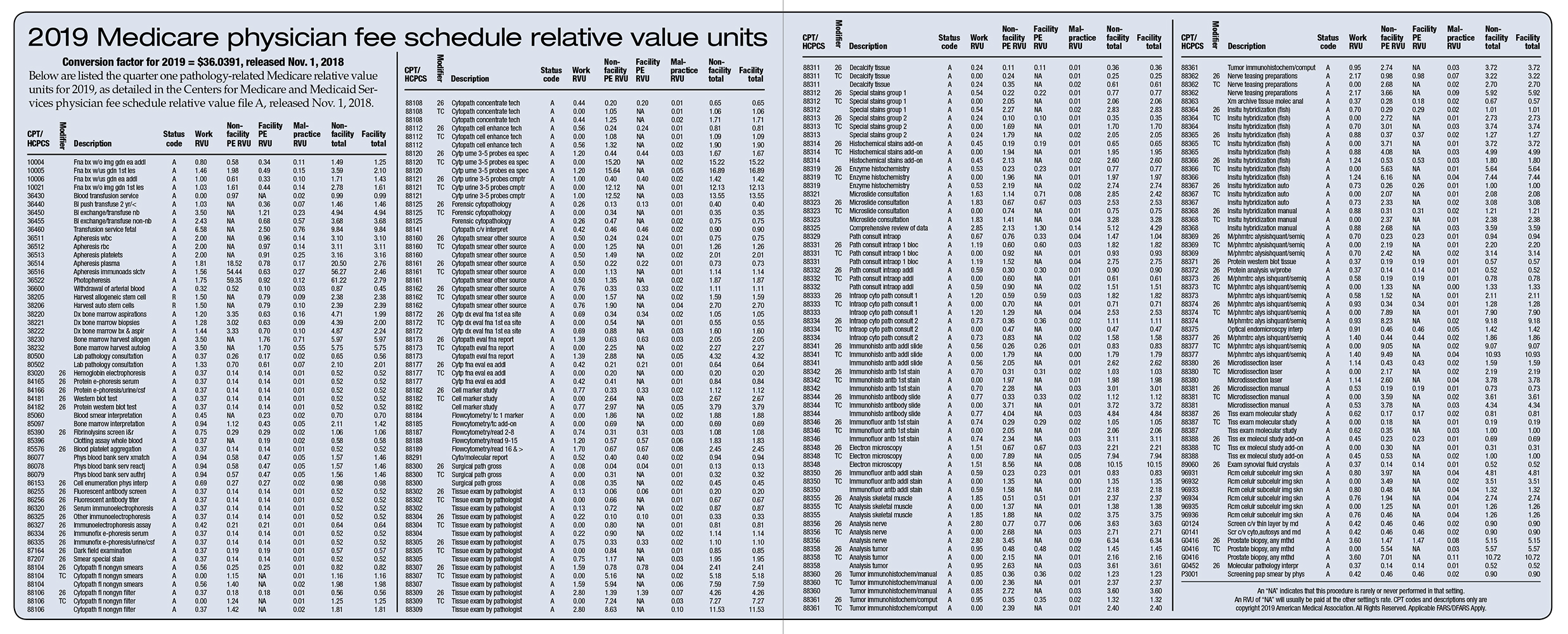
December 2018—The CMS finalized its 2019 Medicare physician fee schedule and its response to the CAP’s recommendations to raise payment for fibrinolysins interpretation and reporting and to forgo a proposed decrease to the physician work value for blood smear interpretation. The Centers for Medicare and Medicaid Services on Nov. 1 published the 2019 physician fee schedule. Services on the physician fee schedule are composed of three relative value units designated by the CMS: physician work, practice expense, and malpractice liability RVUs. Each RVU is separately valued and summed to equal the total RVU for each physician service on the fee schedule. The CAP advocates for the appropriate valuation of pathology services through its representation on the advisory committee of the AMA/Specialty Society Relative Value Scale Update Committee, known as RUC.

AMP case report: Discordant IHC/PCR test results for mismatch repair status in colorectal adenocarcinoma

December 2018—CAP TODAY and the Association for Molecular Pathology have teamed up to bring molecular case reports to CAP TODAY readers. AMP members write the reports using clinical cases from their own practices that show molecular testing’s important role in diagnosis, prognosis, and treatment. The following report comes from Duke University Medical Center. If you would like to submit a case report, please send an email to the AMP at [email protected]. For more information about the AMP and all previously published case reports, visit www.amp.org.

Put It on the Board

Pathologists and population health—
first steps

December 2018—Pathologists and population health—first steps: Pathologists who want to become involved in population health initiatives can take five main steps, say pathologists and laboratory leaders interviewed for an article published online last month in Archives of Pathology & Laboratory Medicine. In “The role of the pathologist in population health,” the authors report on the interviews they conducted and their review of the literature to answer several questions, among them whether pathologists in both large settings and smaller community-based settings can engage in population health (yes), and whether pathologists are in a position to analyze data for population health (“The data are there,” they say, “but getting to the data—and providing meaning out of it—is the hard part”). One of the first steps to becoming involved in any type of population health management activities, the authors write, is to understand the philosophy of the institution’s CEO and senior management.